



Other Options

Beyond LASIK: Other Options
If you have been told in the past that you are not a candidate for LASIK laser vision correction, or are seeking alternative vision correction options, you should consider getting evaluated by Dr. Kieval at Lexington Eye Associates. Not only has LASIK technology changed to allow us to correct higher prescriptions, but there are several other vision correction options available to you!
Refractive Lens Exchange
What is Refractive Lens Exchange?
Refractive Lens Exchange (RLE) is a surgical procedure that uses the same successful techniques as modern cataract surgery. Cataract surgery is now the most common and safest surgical procedure performed in medicine today. The main difference between standard cataract surgery and RLE is that cataract surgery is primarily performed to remove a patient’s cataract that is obstructing and clouding their vision, while RLE is performed to minimize a person’s dependence on glasses or contact lenses.
How does it work?
As an alternative to LASIK, refractive lens exchange replaces the natural lens of the eye with an artificial intraocular lens (IOL). In doing so, the IOL refocuses light to eliminate refractive errors, rather than changing the shape of the cornea as done in LASIK. The accuracy in obtaining the desired improvement is exceptionally high. In some patients, premium intraocular lenses can be used that may be helpful in improving both distance and near vision. Alternatively, patients may opt for distance vision in both eyes or monovision. Implants are intended to last a lifetime and are made of materials like silicone or acrylic that will not affect your sight.

Who is it for?
Refractive lens exchange can be an excellent option for patients who have refractive errors outside the range treatable with LASIK, for those whose farsightedness can be better alleviated with a new lens, or for patients over the age of 50 who have the start of cataract formation. Often, in these circumstances, the procedure can be a better option than laser vision correction and can be equally effective in reducing dependence on glasses or contact lenses.
Understanding Intraocular Lens (IOL) Technology
The two structures of the eye that focus light and allow for perfect vision are the cornea and the lens. In LASIK, the cornea is manipulated to eliminate refractive errors. In cataract surgery or refractive lens exchange, the lens of the eye is manipulated to eliminate refractive errors.
Like the lens of a camera, the eye’s natural lens can change its focus and allow us to see objects up close, a process called “accommodation.”
Therefore, when an artificial IOL replaces the natural lens, it had traditionally been limited to allowing clear vision at only one distance. This technology is known as a non-accommodating “monofocal” IOL.
With the latest advances, having clear vision at only one distance is a thing of the past! Premium IOL technology can not only correct impaired distance vision, but also maintain the eye’s focusing power for reading and computer work.
Multifocal IOLs
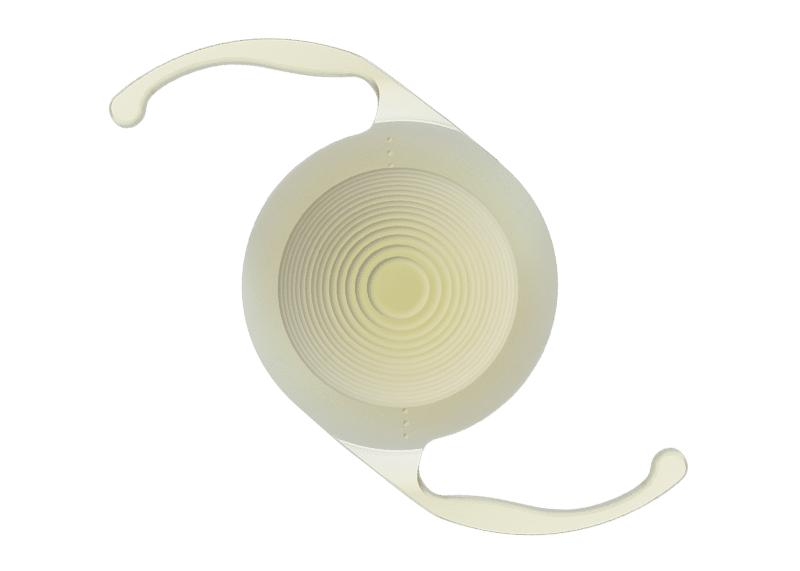
Multifocal IOLs are typically made up of concentric circles that allow for multiple points of focus at distance, intermediate, and near. As with standard IOLs, a multifocal IOL also replaces the natural lens or cataract—the difference being that the multifocal design provides patients with the ability to see images clearly at many distances, not just one as with a standard IOL. For the vast majority of patients, having a multifocal lens implant means that you will be able to see at a distance, up close, and everywhere in between, without being dependent on glasses. Patients choosing to have a multifocal lens implant will likely find that they can drive, watch television, read, or do crafts without the need for glasses.
Below are the types of multifocal IOLs currently approved by the FDA.
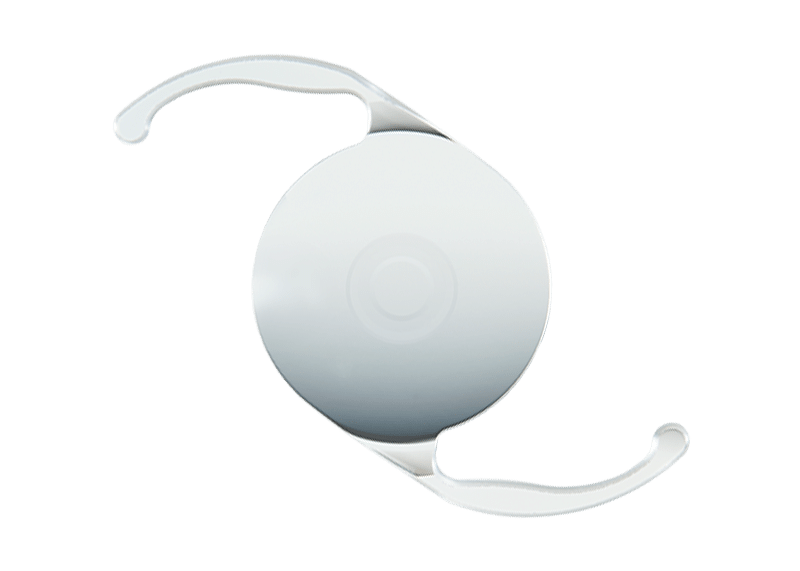
Dr. Kieval will discuss which is likely to best suit your individual needs and provide you the most personalized correction of your vision.
Accommodating IOLs
Accommodating IOLs are also designed to provide a continuous range of vision for distance, intermediate, and near, eliminating or reducing patients’ dependence on reading glasses or bifocals. This is made possible by the IOL’s unique design structure, which allows the lens to move back and forth as it would during natural focusing of the eye. When viewing distant objects, the internal muscles of the eye remain in a relaxed state and maintain the lens in a position to provide perfect distance vision. As the internal muscles of the eye contract during periods of reading, the visual portion of the lens is moved forward, shifting one’s focus to the near tasks.

Currently, the first and only FDA-approved accommodating IOL is the Crystalens. Dr. Kieval will be able to discuss whether an accommodating IOL is the right choice for your visual needs.
Toric IOL
Toric IOLs are lenses that correct astigmatism in order to allow for clear vision without a pair of glasses. All other IOLs do not provide correction of astigmatism such that a patient would require glasses if they had a significant amount of astigmatism in their eye. With a Toric IOL, astigmatism can be corrected, allowing for the clearest possible vision. One must keep in mind that Toric IOLs are monofocal lenses. Thus, Toric IOLs are not capable of providing both distance and near vision correction without glasses, but they are an excellent alternative for patients with significant amounts of astigmatism.

Phakic Intraocular Lens
In the Phakic Intraocular Lens (IOL) exchange procedure, an intraocular lens is placed inside the eye. However, as opposed to cataract surgery or a refractive lens exchange, the natural lens is not removed. In the simplest terms, it is as if a contact lens is placed inside one’s eye and never has to be changed again.
Individuals who suffer from extreme nearsightedness or thin corneas now have a solution to provide visual independence. Whereas patients with extremes of nearsightedness or thin corneas have not been candidates for laser vision correction, phakic IOLs provide an opportunity to give these patients the change to experience the same lifestyle change that LASIK has brought to millions.
Currently, two lenses are approved for refractive surgery as a phakic IOL:
Corneal Inlays
Although synthetic corneal inlays have been investigated for the past 40 years, these devices are not currently FDA approved for use. Inlays are small artificial lenses that are inserted into the cornea to change the focus of light and correct refractive errors. They hold the most promise and are currently being advocated primarily as a means for the correction of presbyopia.
The advantages of corneal inlays include the ability to correct large refractive errors, or prescriptions, for patients that would otherwise not be candidates for LASIK or PRK.
Additionally, they could be used following LASIK correction for a patient’s distance vision, and then be implanted to allow for near vision without glasses as well. Because they do not require insertion inside the eye, there is less risk involved with the surgery. Lastly, they are completely removable, and thus the effects are reversible.
There are currently several models that are in clinical trials and may soon represent a new form of vision correction surgery. These include the AcuFocus KAMRA, Flexivue microlens, and the PresbyLens.
The Procedure
Using the same laser that creates a LASIK flap, a thin pocket is created in the cornea that serves as a channel to allow for insertion. The inlay is then positioned in the center of the cornea. Sutures are not required, and only topical anesthesia in the form of eye drops is used.